Myth: A satellite overhead means you no longer need mobile coverage, indoors or out.
Here is the first thing I tell anyone who asks why we bother bonding networks instead of just pointing a dish at the sky. Most of the connections that matter to people happen inside a building. That is where the myth falls apart.
In its reality check on the ten myths about Starlink, Strand Consult makes the point plainly: more than 80% of mobile data traffic is generated indoors, and a satellite signal cannot pass through a roof and walls to reach it. Physics does not care how many satellites are in orbit. A signal from space loses most of its energy the moment it hits a structure. By the time it reaches a phone two rooms in, there is almost nothing left.
So picture a real site. A warehouse on the edge of town. A clinic. A house with a metal roof. Outside, in the open, a dish can see the sky and pull a usable signal. Walk inside and that signal is gone. The tower three miles away, on the other hand, is still reaching the building. It is weak, it is noisy, and it is coming from a direction nobody has bothered to aim at. That weak terrestrial signal is still the better path indoors, because it was built to travel through the clutter that satellite cannot.
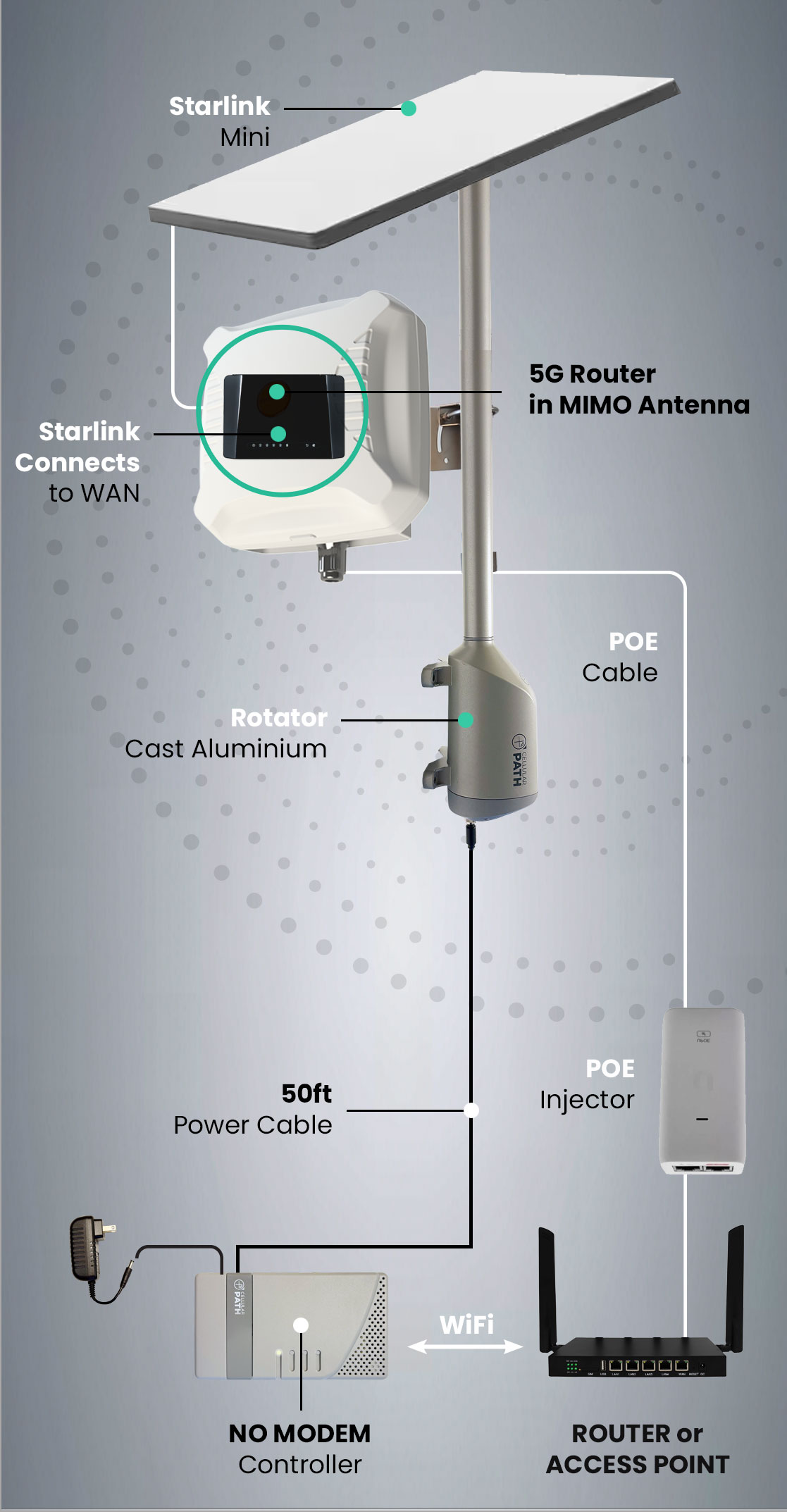
This is exactly where our self-aiming cellular antenna solutions earn their place. We do not sell antennas. We build the rotator and the software that measure every signal present at a site, aim a directional antenna at the best tower, bond that cellular link with satellite when it helps, and monitor the connection so it stays locked on as conditions change.
Measure, aim, bond, monitor. That is the whole thesis, and indoors is where it shows up most.
I have the proof on the bench and in the field. At an urban site surrounded by AT&T towers, putting a Peplink 5G router on a No-Modem SOCA rotator gave us a 10x improvement in upload and 4x better SINR, just by aiming at the right tower instead of accepting whatever the radio grabbed first. We also put the router at the antenna in our Hybrid design, which eliminates 2 to 4 dB of coax loss that a traditional install throws away before the signal ever gets inside. Every one of those decibels matters when you are trying to light up a building.
A dish alone cannot do this. It sees one path, straight up, and when that path is blocked it has no backup. The best connection at a site is never one network. It is the best combination of every network present, and something has to measure, aim, and bond in real time to find it.
See it for yourself. Our interactive demo walks through exactly how a SOCA scans, locks on, and reports: try the interactive SOCA demo.
So here is my question for anyone betting the building on a single link from the sky: when 80% of your traffic lives indoors, why would you aim at the one place your signal cannot follow?
This post is part of the Hybrid Myths series, a builder’s response to Strand Consult’s research. Source and full credit: Strand Consult, “The 10 Myths About Starlink: A Reality Check for Telecom Operators, Investors and Regulators.” The analysis and commentary here are my own; the underlying myth framing and research belong to Strand Consult.